
Italy gave Carl Frederic Aagaard a different landscape to work with, but it didn't require him to abandon the qualities that made his paintings recognizable. The forests and lakes of Denmark gave way to steep hills, Mediterranean vegetation, stone architecture and the clear geography of places such as Lake Como and the Amalfi Coast. The scenery changed. His way of organizing it remained remarkably consistent.
Aagaard made extended study trips to Italy during the 1870s, bringing back sketches that later served as the basis for studio paintings. Fondation Custodia notes that these Italian journeys produced a large body of drawings and sketches that Aagaard used when developing his finished works. His Italian paintings are therefore interesting not simply as records of travel, but as examples of how he translated unfamiliar places into carefully structured landscapes.
Look at the Italian paintings together and a pattern begins to appear. Water often provides the middle distance. Architecture gives the eye a place to enter the scene. Trees and vegetation establish the foreground, while mountains or distant hills close the composition. The geography of Italy becomes part of the design.
Lake Como
The clearest example may be Lodge on Lake Como. The painting brings several elements together that Aagaard could use repeatedly in his landscapes: a building close to the viewer, vegetation around it, an open body of water and a distant mountain landscape.

The effect is not simply a panoramic view. The architecture gives the foreground weight. The lake then opens the scene, creating a broad horizontal space between the viewer and the mountains beyond. The eye moves outward in stages.
That structure is important. Aagaard was not treating Lake Como as a single spectacular view. He was arranging the landscape so that each element has a role. The lodge establishes the human presence. The lake creates distance. The mountains provide the final boundary.
It is also a useful painting to consider when looking at Aagaard's Italian work as a whole. The Mediterranean setting may be unfamiliar, but the basic logic is close to the way he approached northern landscapes. Nature is not left as an undifferentiated expanse. Trees, water, buildings and distant landforms are given distinct positions.
Amalfi and the sea
The geography becomes more dramatic in View to the Amalfi Coast. Here the landscape falls toward the sea rather than opening across a relatively contained lake. The coast itself creates a sequence of slopes, cliffs and distant settlements.

The painting is recorded as a view of the Amalfi Coast from the Convento dei Cappuccini, with the composition looking along the steep coastline. The site catalogue dates the work to 1894 and gives its dimensions as 65.5 by 85 cm.
The difference from Lake Como is immediately useful. At Como, the water sits within a landscape enclosed by mountains. At Amalfi, the sea opens outward and the land seems to descend toward it. Aagaard adjusts the composition accordingly.
The architecture is no longer simply a lodge beside the water. The built environment is integrated into the geography. Buildings cling to slopes, terraces occupy narrow spaces and the coastline becomes a series of overlapping planes.
There is less sense of a quiet enclosure. More of the world seems to extend beyond the edge of the canvas.
Architecture and vegetation
Architecture plays an unusually important role in Aagaard's Italian landscapes. It gives him something that trees and mountains cannot always provide: a strong, clearly defined shape close to the viewer.

Pergola in Amalfi is a good example. The pergola creates a transition between architecture and nature. It is neither a separate architectural study nor simply a frame around the view. It belongs to the landscape.
That distinction matters. Italian architecture gave Aagaard opportunities to place walls, columns, terraces and shaded structures against open sky and distant scenery. Vegetation could then soften those hard forms. Leaves and branches occupy the edges of the architecture, while the view beyond pulls the eye toward the larger landscape.
The result is a conversation between built and natural forms. A stone column has a different visual weight from a tree trunk, but both can establish verticals. A terrace can create a horizontal line much like the surface of a lake. A pergola can frame distant hills in much the same way that a forest opening can.
Aagaard seems to have understood these relationships well.
Ancient Italy
Ancient Columns, Italy takes the architectural element in another direction. The columns are not part of a contemporary villa or lakeside residence. They introduce the remains of an older Italy into the landscape.
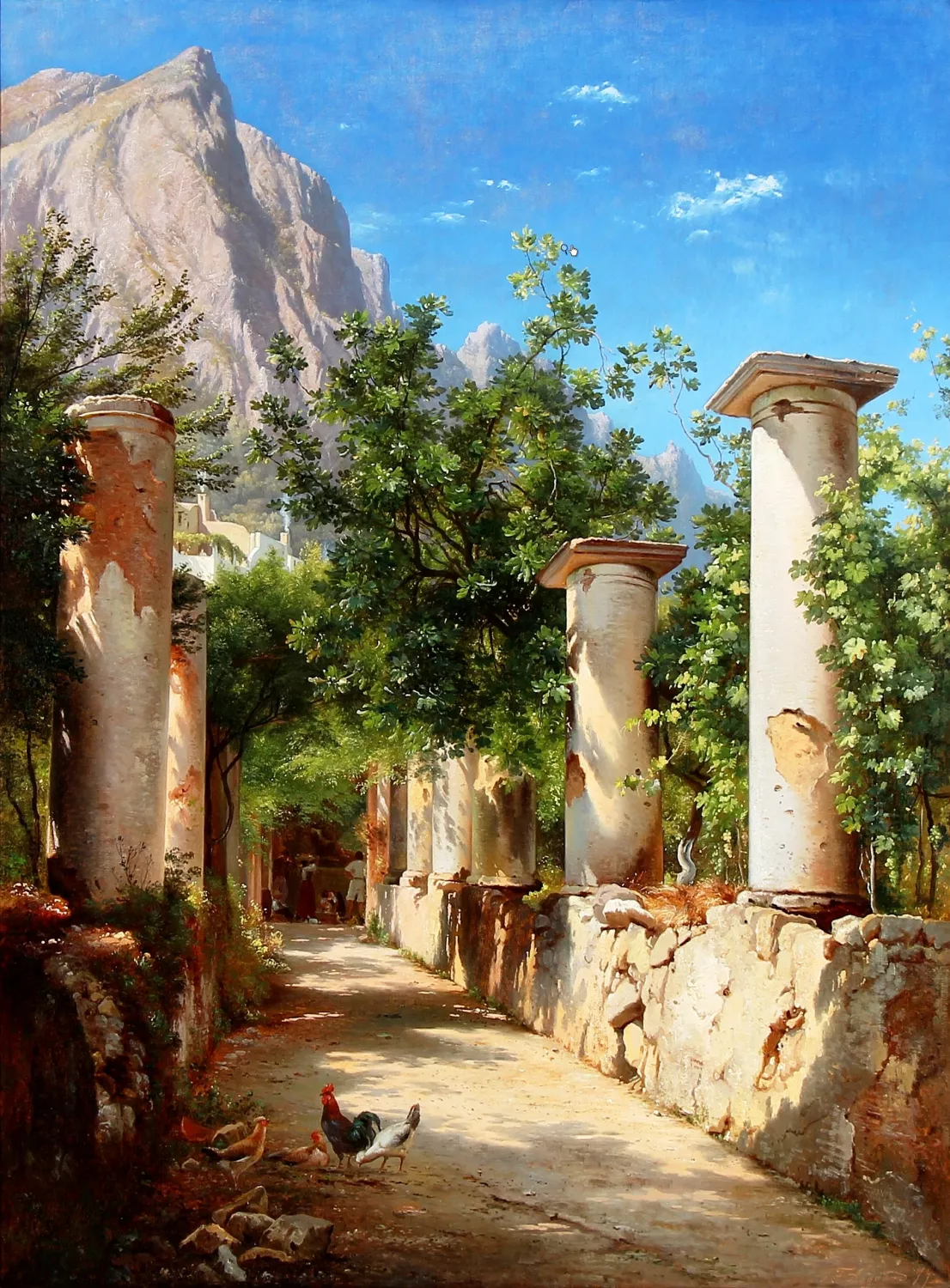
The painting is a vertical composition, unlike the horizontal views of Lake Como and the Amalfi Coast. That change in format suits the subject. Columns naturally establish strong vertical lines, while the surrounding landscape provides space and depth.
Here, history becomes part of the scenery.
Aagaard doesn't need to turn the ruins into an archaeological statement. The columns can simply exist within the landscape, surrounded by earth, vegetation and distant forms. The contrast between the aged stone and living vegetation gives the scene its character.
This is one of the reasons Italian subjects offered him so much material. The landscape was never only about mountains or water. It came with architecture, ruins, villages and traces of earlier civilizations. Each could become a structural element within a painting.
From north to south
Seen together, these paintings show that Aagaard's interest in Italy was not limited to one type of scenery. Lake Como offered enclosed water and mountain distance. Amalfi provided steep coastal geography. Pergolas and lodges introduced architecture into the foreground, while ancient columns brought history directly into the landscape.
The vegetation changes as well. Northern European woodland has a different density and character from the vegetation surrounding an Italian terrace or coastal structure. Yet Aagaard continued to use plants in much the same compositional way. They could establish the foreground, partially frame the view and create a gradual passage from the immediate scene into the distance.
Water remained just as useful. The lake at Como and the Mediterranean beyond Amalfi are very different bodies of water, but both help organize the paintings around a clear relationship between foreground and distance.
That may be the most interesting thing about Aagaard's Italian landscapes. He traveled far enough to encounter a radically different visual world, yet he did not simply reproduce everything he saw. He selected, arranged and simplified the scenery into compositions that could work as paintings.
Italy through Aagaard's eyes
The Italian paintings also make the relationship between travel and studio painting easier to understand. Aagaard's journeys supplied him with places, sketches and visual information, but the finished works were carefully constructed. His Italy is recognizable, yet it is also shaped by the habits of a Danish landscape painter trained to think about balance, distance and the relationship between natural forms.
That is why Lodge on Lake Como and View to the Amalfi Coast feel related even though the places themselves are so different. One looks across a northern Italian lake, the other toward a steep Mediterranean coast. Both are built from the same basic question: how can a landscape lead the eye from something close at hand toward something much farther away?
Italy gave Aagaard new answers to that question. Stone terraces replaced familiar Danish structures. Mountain slopes replaced low horizons. Mediterranean vegetation took the place of northern woodland. The water changed too.
But the underlying fascination remained the landscape itself, carefully observed and carefully arranged. Looking from one Italian painting to another, the geography changes dramatically. The painter's eye does not.